Best Home Gym Equipment for Beginners (2026)
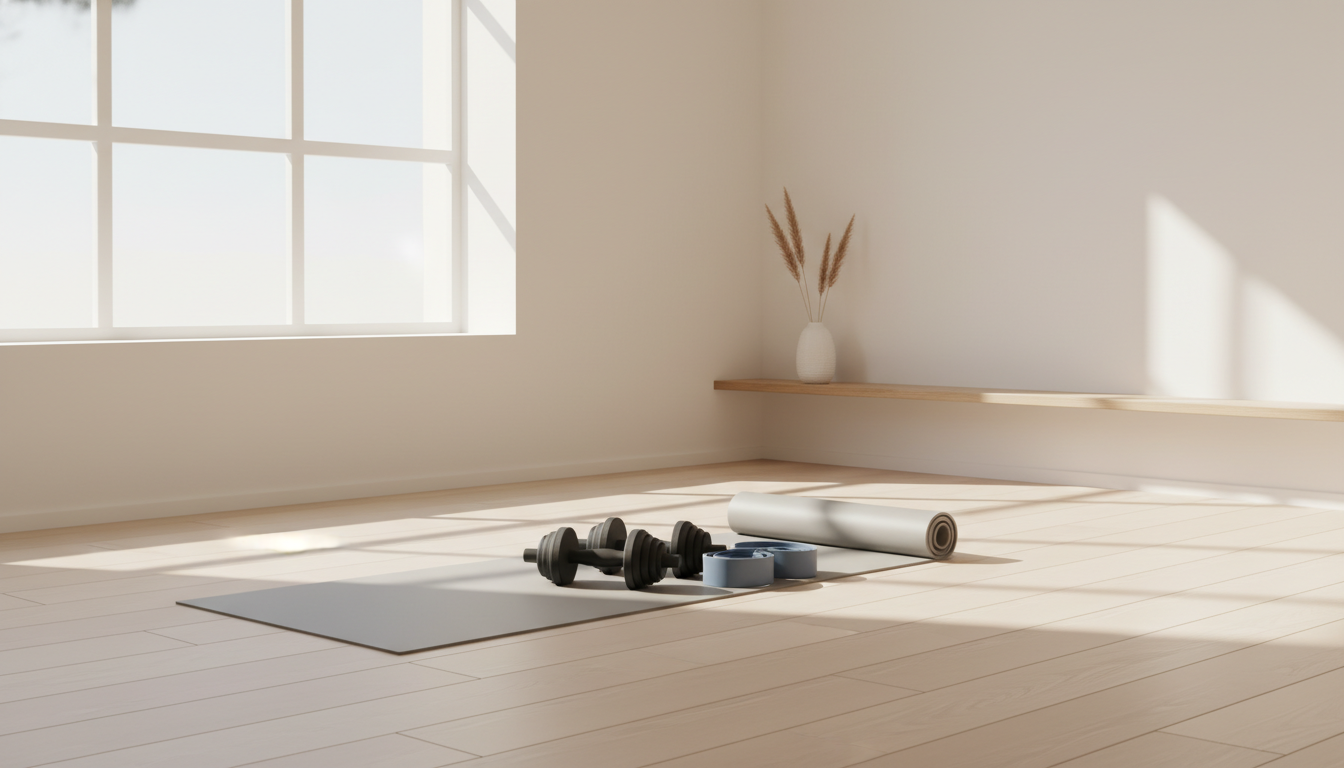
Most beginners buy too much, too fast, and end up with a cluttered room and a light wallet. The smarter move is five or fewer pieces of equipment that cover strength, conditioning, and progression—then add from there. Here’s what actually earns its floor space.
The Non-Negotiable First Buy: Adjustable Dumbbells
A fixed dumbbell set takes up a rack’s worth of space and costs a fortune to build out. Adjustable dumbbells solve both problems. The Bowflex SelectTech 552 adjusts from 5 to 52.5 lbs in 2.5 lb increments—enough range to cover everything from shoulder raises to goblet squats for most beginners.
The Rep Fitness and PowerBlock lines are also solid if the Bowflex is backordered, but the SelectTech 552 has the smoothest dial mechanism and is easiest to find in stock.
One pair handles push, pull, hinge, and carry patterns. That’s your entire program for the first six months if you use them consistently.
A Barbell and Plates (If You Have the Space)
If your space allows even a 7-foot bar, a barbell unlocks squat, deadlift, bench, and overhead press—the four lifts that build the most total muscle. For beginners, the CAP Barbell Olympic Bar is a legitimate starting point: around $150, holds up to standard loading, and widely available.
Pair it with bumper plates rather than iron if your floor isn’t protected—they’re quieter and safer when you miss a lift. The Rep Fitness Bumper Plates offer good value per pound compared to name brands.
Skip the barbell for now if your ceiling is low, your floor is concrete with no matting, or your space is under 8 feet wide. Dumbbells will carry you further than a crowded barbell setup.
A Bench That Does More Than One Thing
A flat bench is fine. An adjustable bench is better. The REP Fitness AB-3000 hits every incline angle, holds up under heavy loading, and folds upright to save space. Around $200-$250.
Incline angles matter more than beginners expect. Incline dumbbell press, seated shoulder press, and incline rows are all distinct movements—and you can’t do them with a flat bench.
Look for a bench rated to at least 600 lbs, minimal pad wobble at full incline, and a footprint under 50 inches when folded. Cheap benches flex and wobble under load; that’s a stability problem, not just a comfort issue.
Resistance Bands: Underrated and Underbought
A set of loop bands or pull-up assist bands costs under $30 and adds mobility work, activation drills, and banded variations to almost any exercise. Fit Simplify Resistance Loop Bands are a reliable entry-level set with five resistance levels.
Bands are especially useful for:
- Glute activation before squats and deadlifts
- Face pulls and external rotation work
- Assisted pull-up progressions
- Stretching and mobility routines
They weigh nothing, store in a drawer, and add genuine value even after you’ve built out a full rack setup.
A Pull-Up Bar (And Why to Buy One Early)
Pull-ups and rows are the most neglected movement pattern for beginners because there’s no easy machine substitute at home. A doorframe pull-up bar fixes that for under $40.
The Iron Gym Total Upper Body Workout Bar fits most standard door frames without screws, supports up to 300 lbs, and doubles as a push-up handle on the floor. It’s not glamorous, but it works.
If you can’t do a full pull-up yet, hang your resistance band over the bar and use it for assisted reps. The movement pattern still trains the same muscles while you build to bodyweight.
What to Skip (For Now)
Beginners consistently overspend on things that don’t move the needle:
- Cable machines: Useful eventually, but dumbbells and bands replicate most cable movements well enough for the first 12-18 months.
- Smith machines: Lock you into a fixed bar path that interferes with learning real movement patterns. Skip entirely.
- Cardio machines: A jump rope ($15) and your neighborhood do the same job. Save the floor space.
- Weight benches with built-in preacher curl attachments: These look useful, wobble in practice, and waste money.
The goal for your first setup is movement variety, not equipment variety.
How to Prioritize If Budget Is Tight
Start here, in order:
- Adjustable dumbbells (~$300-$400) — the highest ROI purchase in home gym equipment
- Pull-up bar (~$35) — covers your entire pulling pattern
- Resistance bands (~$25) — mobility, activation, progressions
- Adjustable bench (~$200-$250) — unlocks pressing variations
- Barbell + plates (~$300-$400 for starter setup) — add this when you’ve outgrown dumbbell loading
That full list runs $860-$1,100, covers every major movement pattern, and fits in a one-car garage or a spare bedroom corner.
Bottom line: Adjustable dumbbells and a pull-up bar get most beginners 80% of the way there. Everything else fills in the gaps as your training matures. Buy quality on the first two, and be patient with the rest.
Where to buy
- Bowflex SelectTech 552
- CAP Barbell Olympic Bar
- Rep Fitness Bumper Plates
- REP Fitness AB-3000
- Iron Gym Total Upper Body Workout Bar